
Feliz cumpleaños, María
The legend who never asked for permission
Some icons are remembered. Others are felt.
María Félix belongs to the second kind.
Also known as La Doña and María Bonita, she was born on April 8, 1914, in Álamos, Sonora and left this world on the exact same day in 2002.
El mismo día, 88 años después.
Almost as if she had written her own ending Or simply refused to leave anything to chance.
María didn’t become famous, she redefined presence
At a time when women on screen were often written as soft, secondary, or submissive, María Félix chose something else entirely:
Power. Irony. Desire. Control.
She didn’t play characters that waited to be saved.
She played women who owned land, who made decisions, who walked into a room and shifted it.
After her role in Doña Bárbara (1943), the world began calling her La Doña. And the name stayed not as a title, but as a declaration.
A career that began by accident and never played small
María's story in cinema didn’t begin with ambition.
It began with a moment.
Walking through downtown Mexico City, she was spotted by a director who asked if she had ever considered acting. That encounter would change everything.
María was even taken to Los Angeles and introduced to MGM an open door into Hollywood. But María chose differently, she chose México.
And from there, she built something bigger than any one industry could contain.
Over the course of her career, she starred in 47 films across México, France, Italy, Spain, and Argentina. She became one of the most recognized faces of Mexican cinema internationally not by adapting, but by staying entirely herself.
No fue solo una estrella del Golden Age.
She carried México with her, wherever she went.
She didn’t follow an image she created one
María Félix wasn’t just an actress.
She was architecture.
Of style, of character, of self.
She understood something few people do: that identity can be designed, refined, and expressed intentionally.
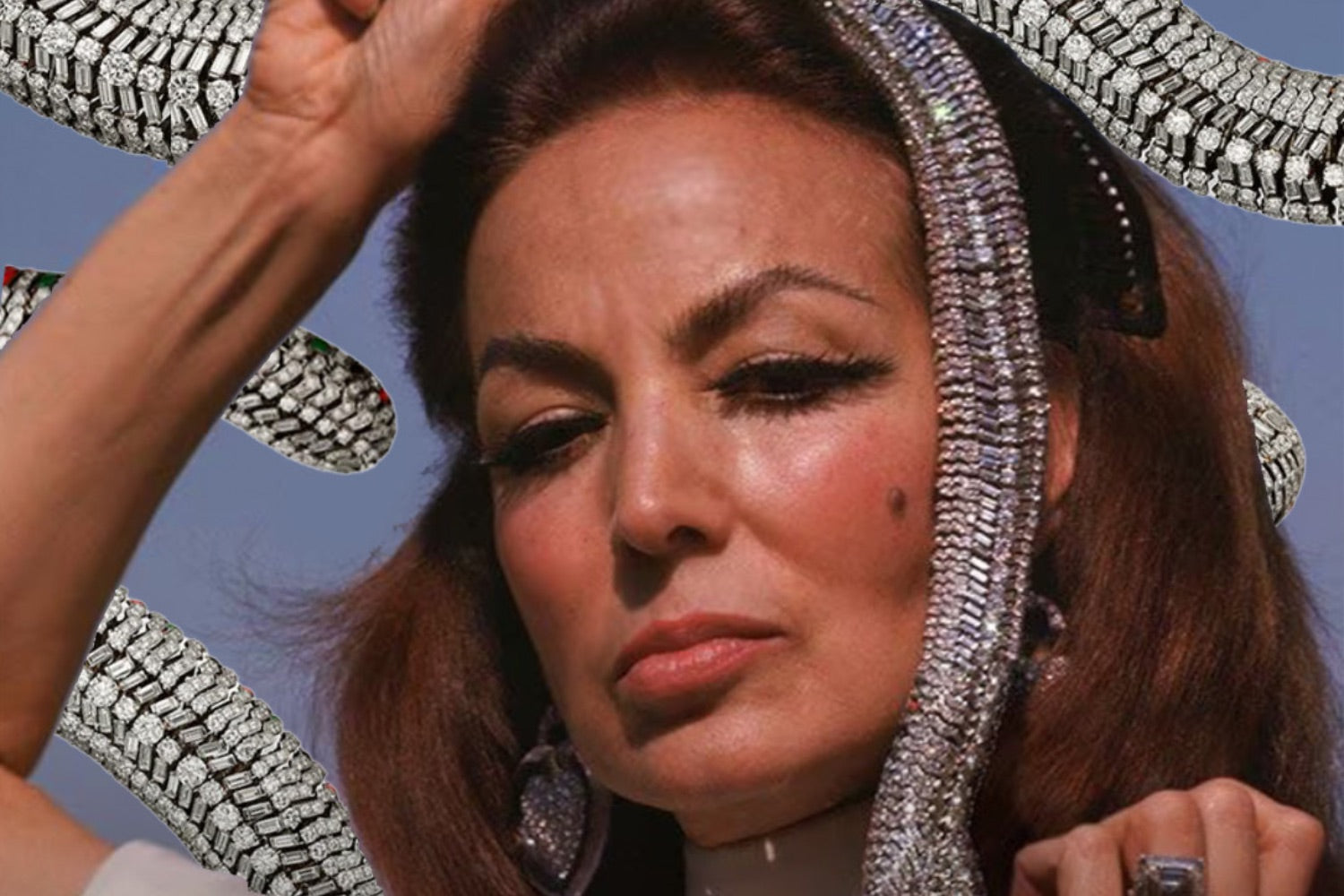
Her presence extended far beyond the screen. She became a muse to some of the most important fashion and jewelry houses in the world Dior, Saint Laurent, etc. but her relationship with Cartier became legendary.
Not because she wore jewelry. Because María transformed it.

The mythology of Maria's style
In 1975, María Félix commissioned what would become one of the most iconic pieces in jewelry history: the crocodile necklace by Cartier.
Two sculptural reptiles one encrusted in diamonds, the other in emeralds — intertwined across her collarbone. Powerful, surreal, impossible to ignore.
But this wasn’t about extravagance for the sake of it. It was about narrative.
Snakes, crocodiles, panthers creatures of strength, danger, and mystery became extensions of her identity. Symbols of control, sensuality, and independence.
María didn’t accessorize. She communicated.
La Doña, in her own words
Her legacy lives not only in film or fashion, but in language. Sharp, direct, unforgettable.
“La belleza te lo da todo, pero no es todo.”
Beauty gives you everything but it isn’t everything.
She understood beauty as power, but never as definition. It was a tool, not a limit.
Her wit was as legendary as her image. Her words carried the same precision as her gaze.

A woman ahead of her time
María Félix didn’t wait for the world to change.
She moved ahead of it.
In a deeply patriarchal era, she demanded control over her roles, her image, and her career. She became one of the highest-paid actresses of her time. She chose her scripts. She shaped her narrative.
She wasn’t trying to represent women. She was redefining what they could be: Independent, complex unapologetic.
Her presence challenged the idea that femininity had to be soft to be accepted.
More than cinema, a cultural force
Her impact extended far beyond the screen.
She inspired artists like Diego Rivera and Leonora Carrington. She was immortalized in songs by Agustín Lara.
She became a reference point in global fashion.
But more than anything, she became a symbol of México, of strength, of a certain kind of beauty that refuses to dilute itself.
As Octavio Paz once said, María Félix was born twice: once by her parents, and once by herself.
And that second birth the one she constructed, defined, and embodied is the one that made her eternal.
The mirada that changed everything
There’s something about her eyes. Not just how they looked but how they moved.
How they held space. How they challenged, invited, dismissed, all at once.
In many of her films, the camera lingered — not on action, but on presence. On the smallest gestures. On the architecture of her face.
Her mirada didn’t ask to be understood. It demanded to be seen.

What made her iconic
It wasn’t just beauty. It wasn’t just talent.
It was the way she moved through the world.
Unapologetic. Sharp. Impeccably dressed. Impossible to ignore.
María Félix wasn’t trying to be timeless. Simplemente era.
From María to you
At AORA, we believe beauty is more than aesthetic.
It’s identity. It’s expression. It’s presence.
Icons like María Félix remind us that makeup isn’t about transformation it’s about amplification.
Your mirada already says something.
The question is: how do you want it to be seen?
MÍRAME
Inspired by color, culture, and expression, our MÍRAME Eyeshadow Palette is an invitation to play with depth, intensity, and light.
To define your eyes not by rules but by instinct.
To create looks that feel bold, intentional, and entirely yours.
Because beauty, like María showed us, isn’t about fitting in.
It’s about being remembered.